Sanitary Sine Pumps
A single sinusoidal rotor moves product in one smooth, near pulse-free flow — gently enough for whole fruit and delicate gels, across viscosities from water to heavy paste. Strong self-priming suction and a wide-open, easy-clean body built to 3-A and EHEDG hygienic design.
Gentle, near pulse-free transfer across every viscosity
A sanitary sine pump uses a single sine-wave-shaped rotor that turns inside the casing, forming four moving chambers that carry product smoothly from inlet to outlet. The flow is steady and almost pulse-free, the chambers are large and open, and there is no close-clearance pinch — so it carries whole fruit, soft solids and delicate gels intact, and pumps anything from thin liquid to heavy paste. It self-primes strongly and strips lines clean. Tell us your duty point and we will size the right model — free, within 24 hours. New to this pump type? Read how a sine pump works.
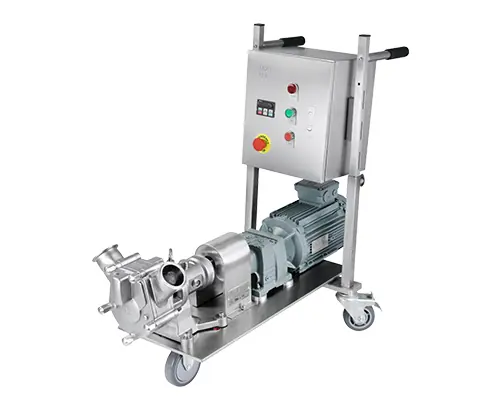
Sine — Standard
- Max flow
- 409 GPM (93 m³/h)
- Max pressure
- 220 psi (15 bar)
- Max temp
- 266 °F (130 °C)
- Flow
- Near pulse-free
- Material
- 316L · Ra ≤ 0.4 µm
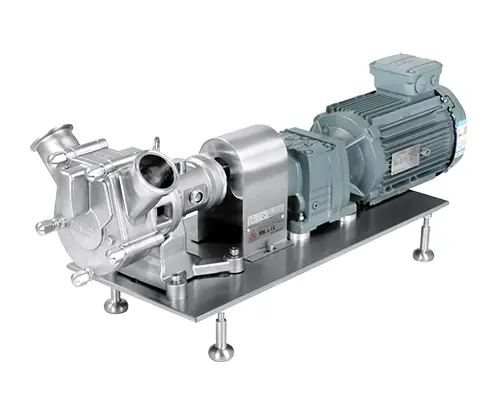
Sine — High-Suction
- Inlet vacuum
- −12.3 psi (−0.85 bar)
- Duty
- Self-prime · strip lines
- Use
- Empty tanks · drums
- Max flow
- 409 GPM (93 m³/h)
- Material
- 316L EP
Sine — High-Viscosity
- Viscosity
- up to 8,000,000 cP
- Duty
- Pastes · gels · fillings
- Max pressure
- 220 psi (15 bar)
- Flow
- Gentle · low-pulse
- Material
- 316L EP
Sine — Gentle / Solids
- Rotor
- Single sine wave
- Duty
- Whole fruit · soft solids
- Shear
- Very low
- Cavities
- Large, open
- Material
- 316L EP
Sine — Mobile Cart
- Format
- Cart / skid
- Drive
- VFD · lockable controls
- Duty
- Move between lines
- Max flow
- 409 GPM (93 m³/h)
- Material
- 316L EP
Sine — Aseptic / Alloy
- Finish
- Ra ≤ 0.4 µm
- Material
- ASME-BPE 316L (1.4435)
- Alloy
- Duplex 2205 · Hastelloy C276
- Clean
- CIP / SIP
- Duty
- Pharma · aggressive media
Specs reflect the DONJOY sine (sinusoidal) pump range we reference: up to 409 GPM (93 m³/h) and 220 psi (15 bar), 130 °C (266 °F) for CIP/SIP, viscosity from 1 to 8,000,000 cP, with inlet vacuum to −12.3 psi (−0.85 bar). Wetted parts in 316L (1.4404), duplex 2205 or Hastelloy C276; surface finish, seals, connections, cart/skid and the supply source are matched to your specification and may be made to order.
Built to the standards your auditor checks
Every sine pump is specified to crevice-free, drainable hygienic design with documented material traceability — 3-A and EHEDG design principles, FDA-compliant materials, with 316L (1.4404) wetted parts electropolished to Ra ≤ 0.4 µm. Duplex 2205 and Hastelloy C276 are available for aggressive media.
Case studies & guides
Real hygienic sine-pump applications and selection guides.
Sine pump FAQs
The questions buyers and engineers ask most before specifying a hygienic sine pump.
What is a sine pump?
How does a sine pump work?
What is a sine pump used for?
What is the difference between a sine pump and a lobe pump?
What viscosity can a sine pump handle?
Can a sine pump handle solids and particulates?
Is a sine pump good for shear-sensitive product?
How strong is a sine pump’s suction, and can it self-prime?
Is a sine pump positive displacement?
Does a sine pump give low pulsation?
Is a sine pump CIP and SIP cleanable?
What is the maximum flow and pressure of a sanitary sine pump?
What materials and hygienic standards does a sine pump meet?
How quickly can you size and quote a sine pump?
About sanitary sine pumps
A sine pump is a positive-displacement pump named for its sine-wave-shaped rotor. The single rotor turns past a fixed gate, forming four chambers that fill at the inlet and empty at the discharge. Each turn displaces a fixed volume, so flow stays steady regardless of discharge pressure — and because the hand-off between chambers is continuous, the discharge is nearly free of pulsation.
Why hygienic processors choose sine pumps
The sine pump is the gentle specialist. Its large, open chambers and single slow rotor add very little shear, so whole fruit, soft solids, emulsions and live-culture dairy pass through intact. It pumps a remarkable viscosity range — from thin liquid to heavy paste — self-primes strongly, and strips lines almost dry to cut product loss. The 316L electropolished wetted parts meet the crevice-free requirements of 3-A and EHEDG hygienic design, with duplex 2205 and Hastelloy C276 for harsh media.
Matching the pump to your process
The right selection balances flow, pressure, viscosity, particle size, shear sensitivity and your cleaning regime. Because it is a positive-displacement pump, flood the suction on the thickest product and fit a relief valve or VFD cutout so it cannot deadhead against a closed valve. For higher-flow, less delicate transfer, compare a rotary lobe pump; for thin, water-like fluids at high flow, compare a sanitary centrifugal pump. Not sure? Send your duty point and our engineers will size it free.
Not sure if a sine pump fits?
Send your duty point — sized free in 24 hours