Sanitary Rotary Lobe Pumps
Gentle, positive-displacement transfer that protects viscous and shear-sensitive product — yogurt, cream cheese, fillings, cosmetics and pharma media. Fully CIP-cleanable, built to 3-A and EHEDG hygienic design.
Protect your product, all the way down the line
A rotary lobe pump moves product gently and at a steady, low-pulsation rate — without crushing particulates, shearing emulsions or aerating cultured product. With no metal-to-metal contact in the product zone and a fully drainable, CIP-cleanable body, it is the default hygienic choice for viscous and shear-sensitive fluids. Tell us your duty point and we will size the right model — free, within 24 hours. New to lobe pumps? Read how a rotary lobe pump works.
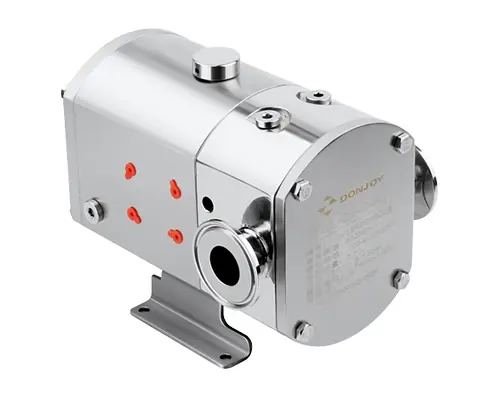
MINI STU-10
- Max flow
- 13 GPM (3 m³/h)
- Max pressure
- 174 psi (12 bar)
- Speed
- 10–1450 rpm
- Finish
- 316L · Ra ≤ 0.4 µm
- Cert
- 3-A · FDA
| Max flow | 13 GPM (3,000 L/h) |
|---|---|
| Max pressure | 174 psi (12 bar) |
| Speed range | 10–1,450 rpm |
| Temperature | −40 to 302 °F (−40 to 150 °C) |
| Surface finish | Ra ≤ 0.6 µm · EP Ra 0.4 µm |
| Wetted parts | 316L, 100% stainless build |
| Connections | Tri-Clamp · DIN (SMS on request) |
| Cleaning | CIP / SIP |
| Certifications | 3-A-02-11 No.1579 · FDA 177.2600 · CE-MD |
The small one. Bench-scale transfer and dosing for labs, pilot lines and low-volume batches — same hygienic build as the full-size range, with a wide 10–1,450 rpm window for fine flow control.
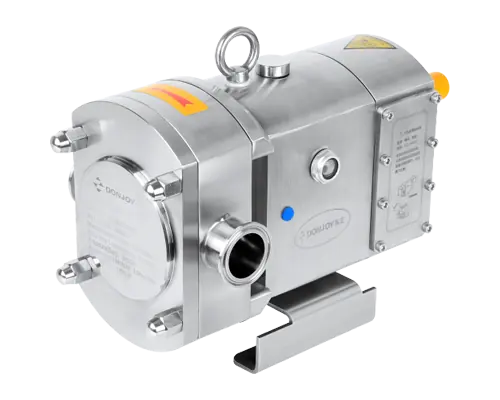
TU Series
- Max flow
- 395 GPM (90 m³/h)
- Max pressure
- 220 psi (15 bar)
- Max speed
- 750 rpm
- Connection
- Tri-Clamp · DIN
- Material
- 316L (1.4404)
| Max flow | 395 GPM (90 m³/h) |
|---|---|
| Max pressure | 220 psi (15 bar) |
| Max speed | 750 rpm |
| Temperature | up to 302 °F (150 °C) |
| Rotors | Butterfly (std) · 3-lobe · 2-lobe · single-butterfly |
| Porting | TUL horizontal · TUR vertical |
| Seals | Single mech (std) · double (opt) · SIC/SIC · TC/TC |
| Surface finish | Ra ≤ 0.8 / 0.6 / 0.4 µm |
| Motors | IE2 wide-voltage · explosion-proof · VFD |
| Certifications | 3-A-02-11 No.1579 · FDA 177.2600 · CE-MD |
The workhorse of the range. Rotor profile, porting and seals get matched to your product — butterfly rotors cover most duties; 2-lobe suits larger soft solids.
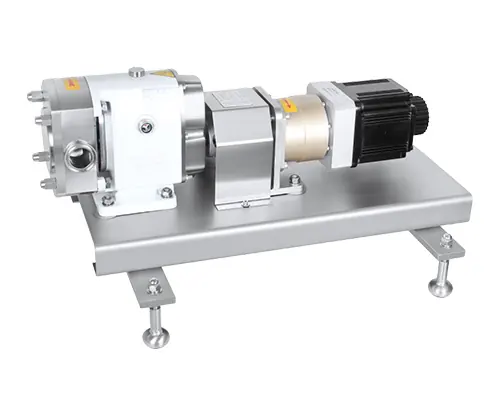
STU Series
- Max flow
- 395 GPM (90 m³/h)
- Max pressure
- 220 psi (15 bar)
- Finish
- Ra ≤ 0.4 µm
- Material
- ASME-BPE 316L (1.4435)
- Cert
- 3-A No.1579
| Max flow | 395 GPM (90 m³/h) |
|---|---|
| Max pressure | 220 psi (15 bar) |
| Max speed | 750 rpm |
| Temperature | up to 302 °F (150 °C) |
| Material | ASME-BPE 316L (1.4435) NB2, Fe ≤ 0.5% |
| Surface finish | Ra ≤ 0.4 µm electropolished |
| Seals | Single / double mechanical · CIP/SIP |
| Connections | Tri-Clamp · DIN (SMS on request) |
| Certifications | 3-A-02-11 No.1579 · FDA 177.2600 · CE-MD |
The TU upgraded for aseptic and pharma duty: full ASME-BPE material traceability, tighter finish, all-stainless externals that stand up to washdown chemicals.
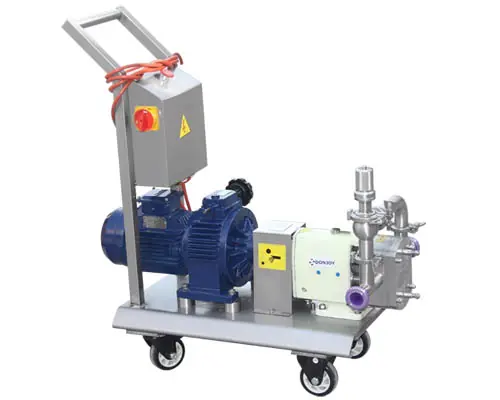
TU + Relief Valve
- Max flow
- 395 GPM (90 m³/h)
- Max pressure
- 290 psi (20 bar)
- Feature
- External relief valve
- Connection
- Tri-Clamp · DIN
- Material
- 316L EP
| Max flow | 395 GPM (90 m³/h) |
|---|---|
| Max pressure | 290 psi (20 bar) with relief valve |
| Relief valve | External, field-adjustable |
| Best for | Good-flowing media, long or restrictive lines |
| Material | 316L electropolished |
| Certifications | 3-A-02-11 No.1579 · FDA 177.2600 · CE-MD |
A positive-displacement pump keeps pushing if a valve closes downstream. The external relief valve gives it somewhere safe to go — protecting pump, seals and pipework while raising the working ceiling to 20 bar.
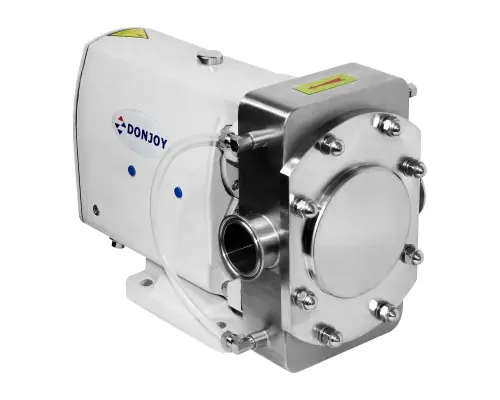
TU + Heating Jacket
- Max flow
- 395 GPM (90 m³/h)
- Max pressure
- 220 psi (15 bar)
- Jacket
- End / outer / full
- Duty
- Chocolate · syrup · candy
- Material
- 316L EP
| Max flow | 395 GPM (90 m³/h) |
|---|---|
| Max pressure | 220 psi (15 bar) |
| Jacket options | End cover · outer casing · full jacket |
| Heating medium | Hot water / steam through jacket |
| Best for | Chocolate, syrup, candy — media that set when cool |
| Material | 316L electropolished |
| Certifications | 3-A-02-11 No.1579 · FDA 177.2600 · CE-MD |
For product that hardens the moment it cools. The jacket keeps the pump head at temperature between runs, so chocolate or hard syrup never sets inside the chamber.
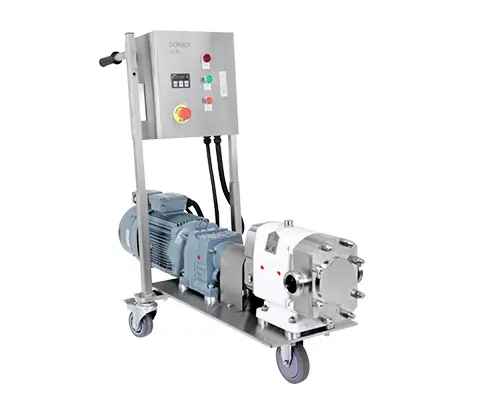
TU + Hopper
- Max flow
- 395 GPM (90 m³/h)
- Max pressure
- 220 psi (15 bar)
- Hopper
- Square / round flange
- Duty
- Non-flowing material
- Material
- 316L EP
| Max flow | 395 GPM (90 m³/h) |
|---|---|
| Max pressure | 220 psi (15 bar) |
| Hopper | Square or round flange, sized to the product |
| Best for | Pastes, doughs and powder blends that will not flow to a pipe inlet |
| Material | 316L electropolished |
| Certifications | 3-A-02-11 No.1579 · FDA 177.2600 · CE-MD |
Some product simply will not run down a pipe. The flanged hopper feeds it straight onto the rotors by gravity, so thick paste moves without an auger or a second feed pump.
No model matches that combination. It does not mean it cannot be built — send your duty point and we will spec one to order.
Specs reflect the DONJOY TU / STU rotary lobe range we reference (3-A-02-11 No.1579, FDA 177.2600, CE-MD). Standard pressure is 15 bar (220 psi); 20 bar (290 psi) with the external relief valve. Rotor (butterfly / 3-lobe / 2-lobe), seals, connections, surface finish and the supply source are matched to your specification and may be made to order.
Built to the standards your auditor checks
Every lobe pump is specified to crevice-free, drainable hygienic design with documented material traceability — built to 3-A-02-11 (No.1579), FDA 177.2600 and CE-MD, with 316L (and ASME-BPE 1.4435) wetted parts electropolished to Ra ≤ 0.4 µm.
Case studies & guides
Real hygienic lobe-pump applications and selection guides.
Rotary lobe pump FAQs
The questions buyers and engineers ask most before specifying a hygienic lobe pump.
How does a rotary lobe pump work?
Is a lobe pump better than a centrifugal pump?
What viscosity can a lobe pump handle?
Can a rotary lobe pump run dry?
Which elastomer should I choose?
Is a lobe pump suitable for CIP and SIP?
Can a lobe pump handle particulates and soft solids?
What hygienic standards do your lobe pumps meet?
How quickly can you size and quote a pump?
About sanitary rotary lobe pumps
Rotary lobe pumps are positive-displacement pumps: each revolution displaces a fixed volume, so flow stays steady and roughly proportional to speed regardless of discharge pressure. Unlike a centrifugal pump, a lobe pump handles high-viscosity product, holds flow against rising back-pressure, and runs gently enough to carry whole fruit pieces or delicate gels intact.
Why hygienic processors choose lobe pumps
Because there is no metal-to-metal contact in the product zone and no close-clearance seal faces dragging through the fluid, the lobe pump runs clean, cool and low-shear. Its open, drainable geometry cleans in place, and 316L electropolished wetted parts meet the crevice-free requirements of 3-A and EHEDG hygienic design.
Matching the pump to your process
The right selection balances flow, pressure, viscosity, shear sensitivity, temperature and your cleaning regime. If your fluid is thin and water-like, compare a sanitary centrifugal pump; for combined transfer-and-CIP duty in a single unit, compare a twin-screw pump. Not sure? Send your duty point and our engineers will size it free.
Not sure which lobe pump fits?
Send your duty point — sized free in 24 hours