Sanitary Flexible Impeller Pumps
A rubber impeller with bendable vanes makes this one of the simplest gentle pumps you can put on a line. It primes itself, pulls from well below the inlet, runs either direction, and moves soft solids without chewing them up. A practical choice for transfer, decanting and emptying tanks in food, dairy and beverage work.
Simple, gentle, and it primes itself
Inside the casing sits a rubber impeller whose vanes flex as they sweep past a shaped cam. The vanes spring open on the suction side to draw product in, then fold over near the outlet to push it out. That flexing is what lets the pump prime dry, lift from a few meters below the inlet, and carry soft solids through without crushing them. Flow is steady and close to pulse-free, and reversing the motor reverses the pump. It earns its keep on lighter transfer and emptying jobs, not high pressure. Send us the fluid and the task and we will tell you the right size and impeller compound. Want the mechanics first? See how a flexible impeller pump works.
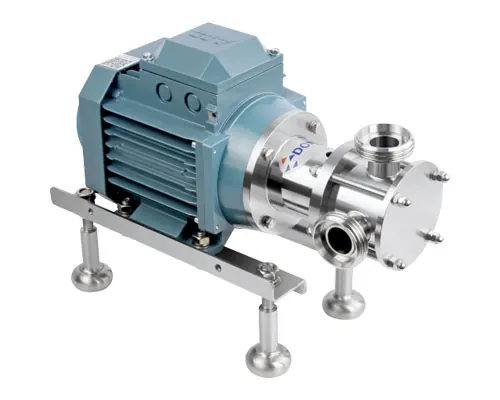
RX — Standard
- Max flow
- 88 GPM (20 m³/h)
- Max pressure
- 58 psi (4 bar)
- Max temp
- 176 °F (80 °C)
- Body
- 316L (1.4404)
- Impeller
- Food-grade elastomer
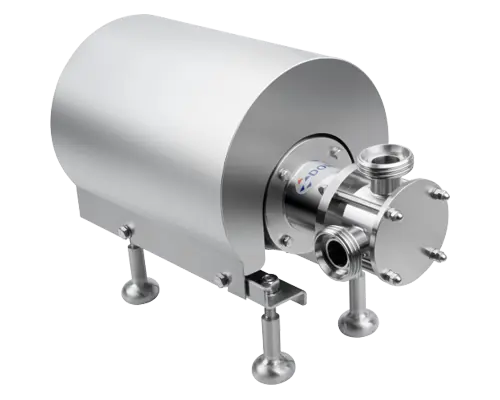
RX — Self-Priming
- Dry lift
- up to 20 ft (6 m)
- Duty
- Empty tanks · sumps · drums
- Prime
- Primes from dry
- Max flow
- 88 GPM (20 m³/h)
- Body
- 316L EP
RX — Gentle / Solids
- Vanes
- Flex around soft solids
- Shear
- Low
- Carries
- Berries · curds · pieces
- Flow
- Near pulse-free
- Body
- 316L EP
RX — Reversible
- Direction
- Forward or reverse
- Use
- Drain lines back to tank
- Drive
- VFD-friendly
- Max pressure
- 58 psi (4 bar)
- Body
- 316L EP
RX — Portable
- Format
- Cart or trolley
- Use
- Batching · decanting
- Move
- Between tanks & rooms
- Max flow
- 88 GPM (20 m³/h)
- Body
- 316L EP
RX — Impeller Compounds
- EPDM
- Dairy · water · CIP
- NBR
- Fats & oils
- FKM
- Aggressive media
- Spare
- Quick-change impeller
- Body
- 316L EP
These specs track the DONJOY RX flexible impeller range we reference: up to 88 GPM (20 m³/h) and 58 psi (4 bar), 80 °C (176 °F), with a dry self-priming lift of about 6 m (20 ft). Bodies are 316L (1.4404); the impeller is a food-grade elastomer (EPDM, NBR or FKM) chosen for your fluid. Connections, finish, cart and impeller compound are picked to suit the job, and the supply source is matched to your specification.
Built to the standards your auditor checks
The wetted metal is 316L (1.4404), electropolished and drainable, and the impeller is a food-grade elastomer that meets FDA material rules. The build follows 3-A and EHEDG hygienic-design principles, so the pump cleans up well and stands up to an audit. We confirm the exact certification path against your market.
Case studies & guides
Where a flexible impeller pump fits, and how to keep it running.
Flexible impeller pump FAQs
What buyers and plant engineers ask us before they spec one.
What is a flexible impeller pump?
How does a flexible impeller pump work?
What is a flexible impeller pump used for?
Can a flexible impeller pump run dry?
Can it handle soft solids and shear-sensitive product?
How well does it self-prime, and how far can it lift?
Can a flexible impeller pump run in reverse?
How long does the impeller last, and when should I change it?
Which impeller compound should I choose?
What flow and pressure can it reach?
Is there an alternative to a flexible impeller pump?
Is it hygienic and easy to clean?
How do I get one sized and quoted?
About sanitary flexible impeller pumps
The flexible impeller pump trades brute capability for plain usefulness. One molded rubber impeller does everything — it primes, it pumps, it handles a bit of solid content — with no gears, no timing and almost nothing to set up. It counts as a positive-displacement pump, since each vane carries a fixed slug of liquid, so the flow holds steady and you can throttle it with speed.
Where it shines, and where it doesn’t
Its sweet spot is light transfer that needs strong suction: pulling a tank down to empty, decanting wine or juice, moving product around on a cart. It primes from dry, lifts well, reverses on command and treats soft product kindly. The trade-off is the impeller itself, which wears and dislikes both dry running and abrasives. For hot, high-pressure or round-the-clock duty, a sturdier pump pays off.
Getting the selection right
Two choices matter most: the size, set by your flow and lift, and the impeller compound, set by your fluid and cleaning chemistry. Protect it with a level switch or dry-run guard if the supply can run out. When the job turns continuous or the pressure climbs, step up to a rotary lobe pump; for very gentle, near pulse-free transfer of fragile product, look at a sine pump. Unsure which way to go? Describe the job and we will point you to the pump that actually fits.
Wondering if a flexible impeller pump suits the job?
Describe the fluid and the duty — we’ll size it and say so straight